Monday, February 15, 2010

WP1: Pre-Writing Assignment 2

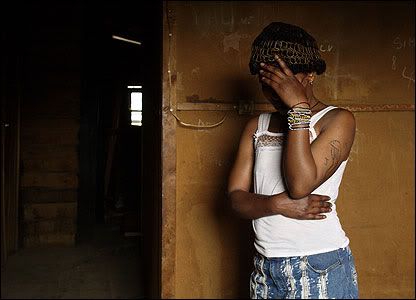
A professional photographer has many technical aspects to think about when shooting a particular subject. By varying the arrangement, framing, lighting, focus, coloration, and many other elements, the photographer can drastically change the way the audience views the photo. In the picture entitled "Tales of Rape in DR Congo," Anna Kari employs many of these technical aspects while capturing the image of a girl in the Democratic Republic of Congo.

The first technical aspect that Kari may have thought about is the arrangement of the subjects within the photo. One notices that the girl takes up about a fourth of the image towards the right side of the picture, and that she is leaning against a bare wall, which extends along the right two-thirds of the photo. The left third, then, is comprised of the receding room within the structure, bathed in darkness. This arrangement and orientation of these subjects gestures toward the appeal of logos, as they give the viewer a sense of the surroundings. Since there are relatively few elements within the composition, the hue of the girl's clothing contrasts with the sameness of the background, producing a hierarchy. Logically, this girl, then becomes the focal point of the piece, which feeds the emotional side of the piece, or pathos. Also contributing to this logos, however, is the way in which the title and the picture work together to inform the reader of the background of the situation. Specifically, the title depicts what has happened to the girl: that she has been part of a rape scenario, and the picture, then, informs the reader how the girl feels about what is depicted in the title.

In going back to the vectors of attention within the photo and seeing how they pertain to the pathos, the girl's eyes attract attention, even though they are not visible. By covering up her eyes, the girl makes no eye contact with the viewer, thus establishing their position as an observer. Nonetheless, the audience is still able to relate,
to some extent, to the emotions that the girl is
projecting. This aspect of the piece thus contributes to the emotions evoked by the viewer. Furthermore, the lighting and coloration of the photo compliment the emotions of the viewer, as the shadows produce many black hues. These hues, which also have very little brightness, typically have negative connotations: gloom, depression, and sadness. Thus, since the majority of the photo contains these hues, these feelings are conveyed to the viewer. In addition, the white top that the girl has on may elicit a feeling of innocence from the reader; especially when viewed with the title.

One last important element in the piece is framing. The photographer chose to get close to the girl; exposing her gestures as well as the bare wall and the dark, mysterious room. This contributes to the emotion of the viewer, but also to the ethos, as it sheds some light on the photographer's opinion of the subject.

Wednesday, February 10, 2010

WP1: Pre-Writing Assignment 1

The above picture is part of a series of nine photos on BBC News' website called "Photo journal, Tales of rape in DR Congo." As seen in the context of this website, the picture is the only image on the page, and it is accompanied by a short 100 word caption that describes the photo's background information. The subject matter of the photo includes a girl from the Democratic Republic of Congo, who is leaning up against a wall in what appears to be her home. Due to the bare walls, naked electrical wires and what appears to be a dirt floor, the home belongs to a lower-class family. In addition, although she is wearing a white shirt and jeans, one can assume that the girl is from the Dominican, as she is wearing beads on her wrist as well as a locally manufactured hat.

Besides the girl's clothing and the condition of the building, there are also many gestures of the photo that depict various aspects of the situation. The girl is is not only leaning against the wall, but she is covering her face with her hand. This specific gesture makes it appear as though she is lonely, ashamed, depressed, etc. When transplanted into the context of the website, the title of the photo substantially increases this feeling, as the word rape emphasizes many of these connotations. Like the girl, the building behind her captures a certain quality or gesture in its primitive state. The shadows within the house created by a lack of lighting give the viewer a sense of unease. All of these combined elements, conditions, subject matter, and gestures culminate in an argument designed to make the viewer react in a particular manner. Personally, this photo makes me feel slightly depressed, and it makes me wonder how it is that peace is such a difficult concept to achieve. Since the depressive state of the girl and the dark, run-down state of the house work together in creating a sense of despair, it is easy for me to have this particular feeling. This, in turn, prompts me to think about the situation. Why did it happen? What is wrong in society that culminates in this scenario of rape?

Saturday, February 6, 2010

Weekly Blog Post 7

Photography is something as an "artist" that I am interested in. I believe that pictures have the ability to depict extremely powerful messages, and as such, I do have a desire to learn how to ultimately capture these themes through the lens of a camera. Growing up, I was exposed to some of the intricacies that go along with taking pictures, as one of my dad's hobbies is to photograph various subjects. In college, he worked for "The Picture Man," shooting weddings and other events, and as a result, he knows a fair amount about the subject. Thus, I have picked up some of the basics through him, such as how to frame pictures in a dynamic way, and a little bit about the lighting. This being said, I am by no means an experienced photographer, nor do I own any sophisticated equipment. I would say that I most enjoy taking pictures of landscapes and older buildings, but am not one of those people who carry a camera with him around the clock (the one on my phone doesn't count). While some people take pictures primarily of their friends to post on facebook, the photos that I end up shooting are mostly during trips, and consist of mountainous scenes, famous buildings, etc. Since I have an interest in painting and drawing, sometimes I will take these pictures and then replicate them via one of these techniques.


As a class, we will be writing our first paper about a photograph, and how it uses various modes of appeal to pose an argument to the viewer. I feel that being able to better analyze and observe photographs goes hand in hand with how well one knows how to take a picture. One aspect of photography that I would particularly like to improve is how to capture light through time. Many times, at night there are scenes, especially in cities, of the lights of cars moving through the streets. Allowing more light to enter the lens via a longer exposure window allow these lines to blur, resulting in a photo that depicts this time. I think that this type of photo has the ability to portray a message about this time, and I would like to learn how to do this.

Tuesday, February 2, 2010

Weekly Blog Post 6

Each and every music video that is created has an argument behind it that the composer is attempting to convey. According to "Compose, Design, Advocate, one essential aspect of this message is the logos presented by the visual portion of the piece. Through the way the layout, structure, and various elements are composed, the author can thus help the audience, "to arrive at the points [he/she] wants to make" (285). In the case of "Thug Story" by Taylor Swift and T-Pain, it is a relatively short clip (1:25), and as such, there is not that much time for them to get across the message that they want. This being said, it makes sense for the video to keep it relatively simple, so-as to not overload the viewer. For the most part, the video is filmed in a parking garage where Swift and T-Pain rap to the camera. Within this scene, there exists a visual hierarchy where T-Pain and Swift are the focal points, with their attire, accessories, and dance moves being a focal point of the production. Occasionally, props are used by Swift in order to reinforce the lyrics, such as a cookie sheet of caramel delights, as well as knitting yarn. Despite these objects, most of the visual elements follow this "thug" look, and are unified through repetition (dance moves, baggy clothes and "bling", etc). The effect of this type of construction is that the audience focuses on the lifestyle that the two have, as portrayed through the video. From the clothes that they wear to how they act, the two look like they are serious thuggers. This, however, juxtaposes the various props that they use, such as parents, cookies, knitting yarn, etc, and causes the audience to think about the situation.

After viewing and listening to the video in its entirety, the argument it tries to portray is that Taylor Swift is not just a country music star who sings about love stories, but is also a dynamic artist who is willing to try new things. Not only can she take her work in stride and do things that her audience might not expect, but she is even willing to poke fun at her own work. The visual arrangement of the video, described above, plays an important part in this argument, as it emphasizes the thug nature that she portrays. This, in turn, aides her argument as it juxtaposes all of the flowery, romantic themes in her previous hit, "Love Story." The use of baggy clothes and thug dance moves, as well as the word play of Thug Story on Love Story make this juxtaposition obvious to the viewer, and this influences both the ethos and pathos of the video. The contrasting themes of the video to Swift's background are there to provoke a sense of comedy from the viewer, as it makes Swift look like someone who can pretend to be someone she is not. These ethos and pathos, then, contribute back to this overall message.

Sunday, January 31, 2010

Weekly Blog Post 5

Towards the beginning of Taylor Swift's "Thug Story," she says, "I'm like eight foot four / Blonde Hair to the floor / You shorties never thought I would be rapping hardcore." In many ways, this short segment of the song represents the piece in its entirety, as it talks about how Swift has turned into a thug rapper. Using these words, she tries to elicit an emotional response, or pathos, from the audience, which ends up varying depending on the views of the particular audience member. Ideally, Swift desires or intends for this pathos of the song to be that of humor, as she having fun playing the part of a rapper. With her background as a blonde country music star producing romantic love-themed songs, Swift does not fit the part of this thug persona. Thus, both her fans as well as the people that don't care for her might realize the irony of the situation, and find the humor resulting from that particular context. Those who adore her, however, might also have a different reaction: anger. Should they view country music as ideal and moral, and rap as the opposite, they might be irritated towards her "stooping down" to that level. This might also occur with rap fans, who view this song with Swift as a disgrace to that particular genre of music.

In her attempt to create an emotional response from the reader, Swift also uses the ethos mode of appeal throughout the clip. By calling her audience "shorties" and telling them that she is now a hardcore rapper, Swift is partially making fun of the "inner rapper" inside of her, and sending her audience a message. She is telling them that she doesn't take her work overly serious, and that she has the ability to joke around and have fun. This same portrayal of T-Pain as someone who can make videos with people like Taylor Swift portrays him in a certain manner to the audience, and this form of ethos is directly connected to pathos. As a result of the way Swift and T-Pain act, the audience is able to take the video in a more light-hearted manner, which will effect their emotions.
Lastly, logos is another mode of appeal that plays a role in the video, as it uses several structures to try and extract a humorous response from the viewer. On page 199 of "Compose, Design, Advocate," the authors say that parallel structures allow the reader to make connections and develop a point of view based on these connections. This is one strategy that is employed within the video, as the visual and audio effects of the video parallel one another in that both are trying to convince the viewer that Swift is a rapper. With this parallel structure, however, comes another structural strategy that is more dominant: a juxtaposition between the way Swift acts and how she has previously portrayed herself. This juxtaposition is something that, again, attributes to the pathos of the audience.