Wednesday, April 7, 2010

WP3: First Post

In the past, I have had some experiences with art objects, and am familiar with a few of the processes used to make art. Ever since I was a youngster, I have had an unconscious fascination with art, and have always enjoyed creating things. Thus, all the way up through middle school, I thoroughly enjoyed the art classes I took. Furthermore, although my schedule in high school didn't allow me to take such courses, I continued to occasionally paint and draw on my on time. Currently, as an architecture student, I am required to take the visual literacy courses, such as drawing and painting classes, in which I have learned how to better create such art. In addition, classes such as Analysis and Composition have allowed me to better understand the form of certain pieces of art using tension, balance, hierarchy, etc.

Besides making some of my own pictures and paintings, I have also had experiences with pieces of art such as paintings, drawings, sculptures, and other instillations by visiting various art museums throughout my life. Besides annually venturing to the Joslyn Art Museum in Omaha, I have experienced art museums in Kansas City, St. Louis, Phoenix, Chicago, and even the Prado in Spain. Some of the works of art that I have found the most fascinating have been mobiles, such as one done by Calder at Joslyn, as well as other three-dimensional, kinetic sculptures. These works in particular have the ability to make you wonder how they work, or sometimes what they even represent. In looking at these various works of art, however, I have not spent more than a maximum of 15 minutes analyzing or looking at any single piece at a time; it is a typical look, think, and move on.

Another form of an art object that I enjoy is architecture. From Taliesin, which is Frank Lloyd Wright's home in Wisconsin, to the ancient castles in Seville, Spain, I am fascinated by the way in which buildings are designed. Furthermore, the way in which they fit into their respective environments is something that can inform the reader about the subject. In a similar manner, I believe that the way in which sculpture is situated and located among its surrounding elements contributes vastly to its meaning.

Tuesday, April 6, 2010

WP2: Final Comic

Author's Note

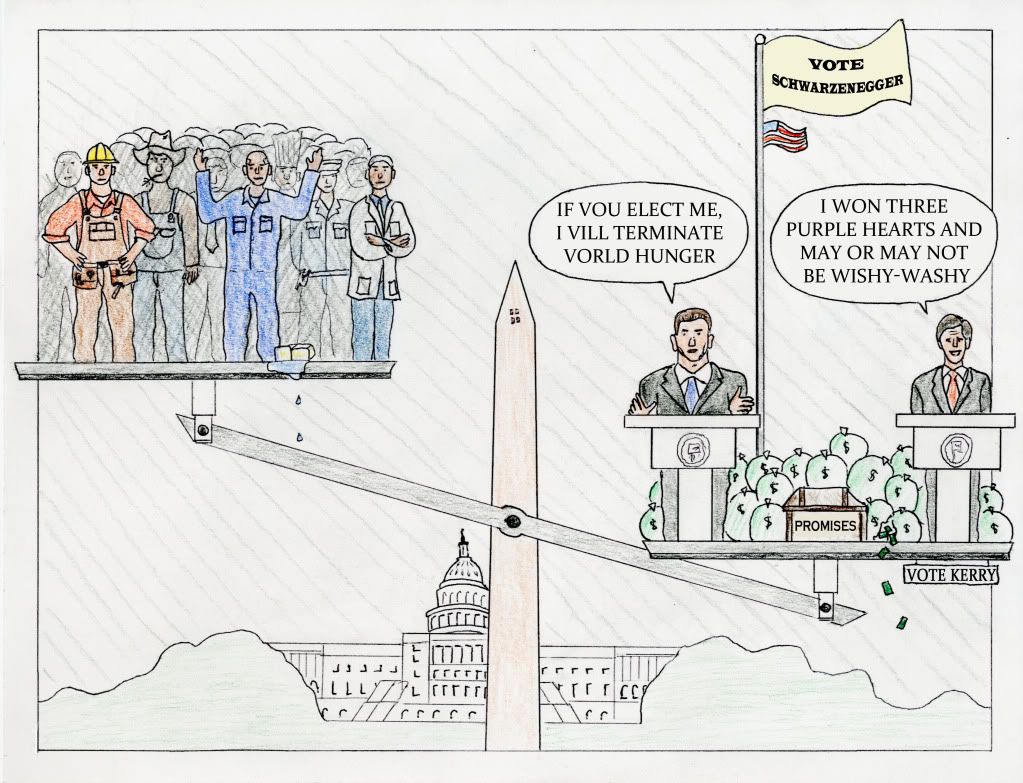
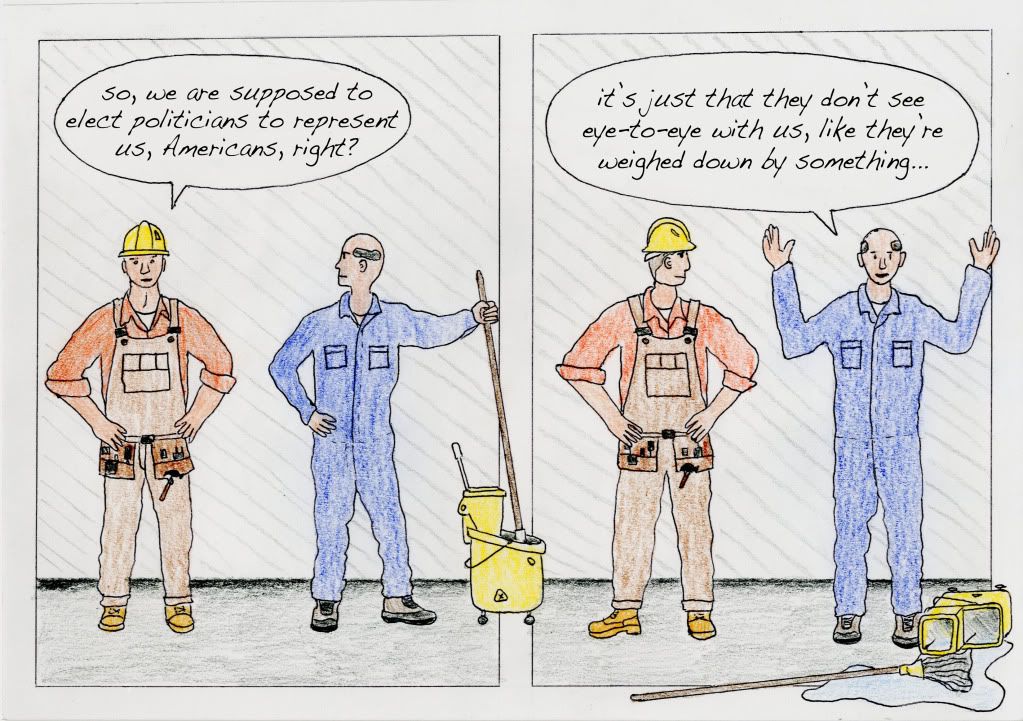
The central theme surrounding my comic, as mentioned in the statement of purpose, is that politicians live in a different world than the average American. As demonstrated through their financial status, fame and fortune, as well as political agendas, the lifestyle of a politician often juxtaposes that of the public, and prompts the questioning of their true representation of the people. Communicating this message to my audience via a comic was no easy task, and it involved an ongoing editing process, working with aesthetic and structural elements.

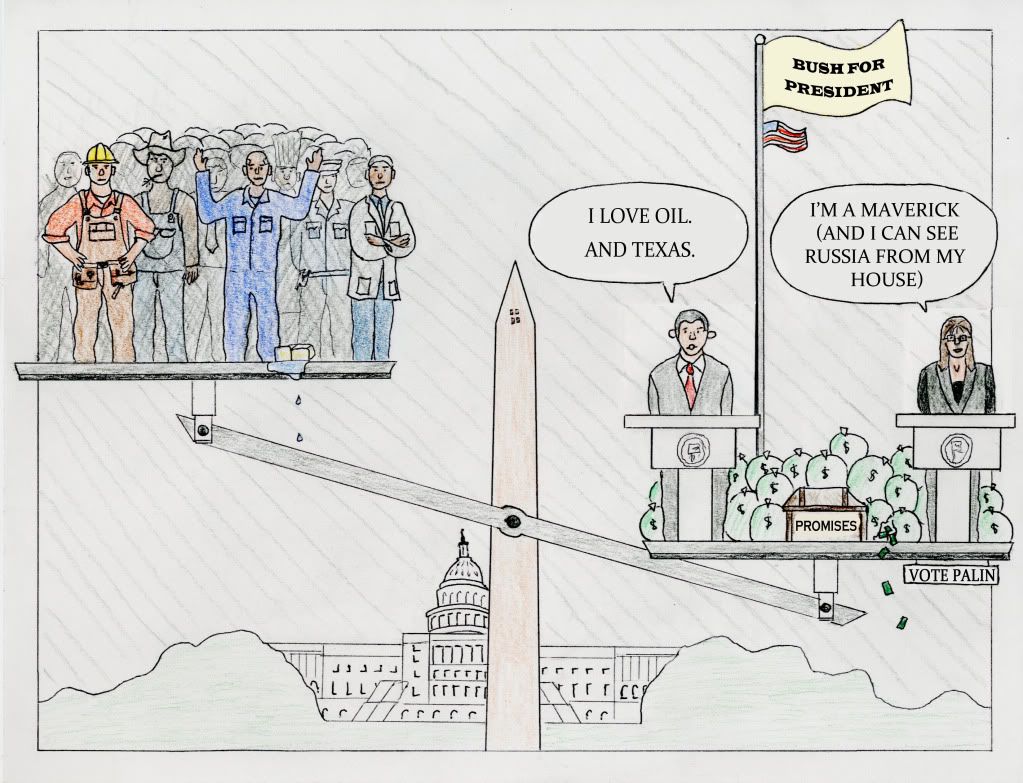
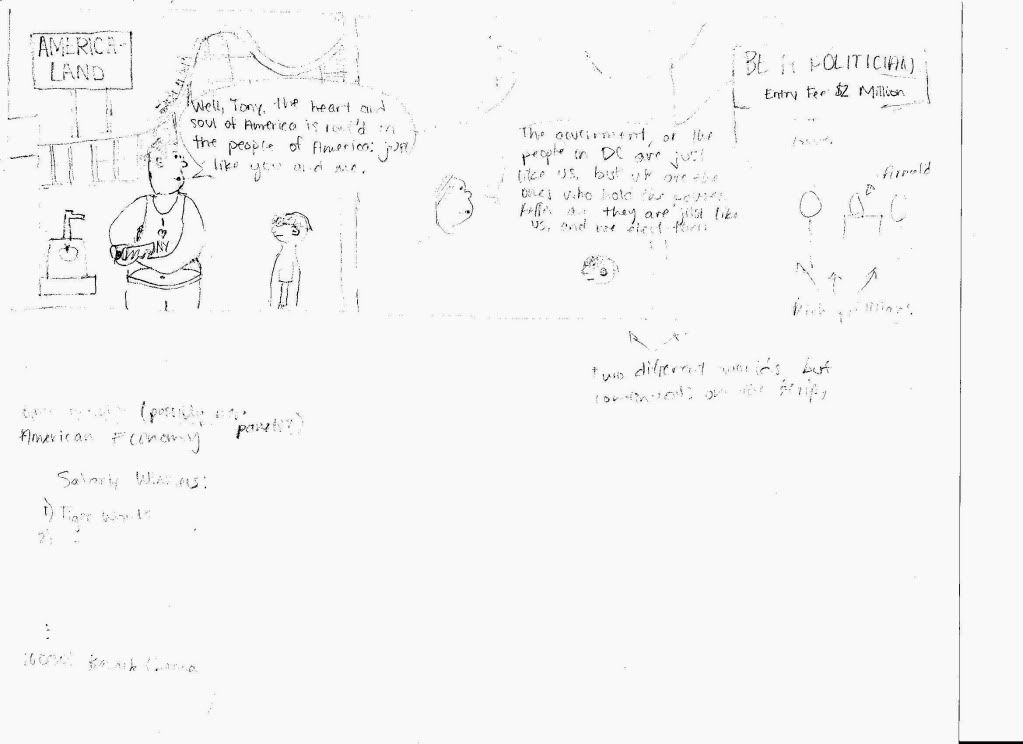
When I originally decided to focus on the differences between politicians and citizens, I foresaw the use of an amusement park with a “political entry booth” as an icon to emphasize the money needed to back a campaign. However, this did not depict some of the other points I wanted to make, and so I decided to use a balance to compare the two groups. Furthermore, in choosing specific iconic people to represent Americans and politicians, I was forced to make decisions regarding who to draw. As pertaining to the citizens, I chose to incorporate many recognizable “blue collar” jobs such as a construction worker, janitor, farmer, etc, while I selected several well-known political candidates for the politicians (from both parties).

In addition, I wanted to add some humor to the message, which is why I included the satirical phrases spoken by the politicians. Although made popular by shows such as SNL, these phrases address some of the same disparity between politicians and the public that I wanted to tackle. Lastly, I had to make aesthetic decisions regarding the typography of the comic. Initially, I hand-wrote the dialect, but eventually decided to use word-processed type for consistency and a professional look. In this way, I was also able to change the fonts between panels: using a lower-case, handwritten font for the everyday workers, versus an uppercase, “professional” font for the politicians.

Also key to this process were the use of rhetorical concepts with which to base aesthetic choices off of. One example of this is that it is especially important within a comic genre to establish a particular pathos and ethos with the audience so that they are able to personally identify with the message. Unlike essays and other such medium, icons in comics can be drawn with varying levels of abstraction. In this way, as stated by McCloud, there exists “amplification through simplification.” Thus, because I wanted the reader to be able to identify with the Americans in the composition, I abstracted these people so that their faces contained few details. In this way, the reader is still able to classify their occupations and what they represent, but also identify with them. The politicians, however, are abstracted much less, so that they are more objective and recognizable.

Another rhetorical concept that is important within the framework of a comic is using icons and symbols to represent various ideas. The main icon I chose to use was the scale, which essentially compares two different groups of people: U.S. citizens versus U.S. politicians. In this manner, I was able to depict using the symbols how the politicians are generally different from everyday citizens. In addition, I juxtaposed the symbolic falling dollar bills with the spilled mop water to further compare these two groups of people. On a larger scale, I chose to incorporate the Washington Monument and Capital building to address through logos what is affected by this conflict.

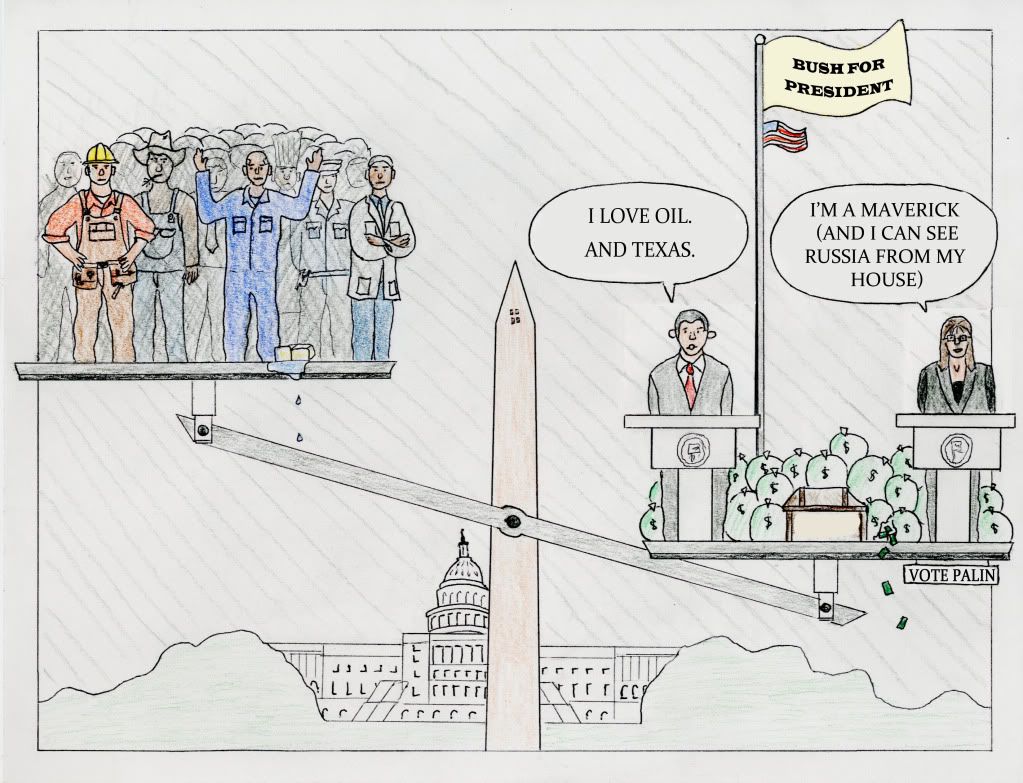
Lastly, in order to make the comic unique, I tried to break away from some of the norms associated with that medium. One such decision, which engages the audience, is to sever the frame of the various panels with the subject matter. By intersecting the frames with the mop bucket and scale, the audience’s attention is called to this subject matter, making them think about what the objects represent and how they fit into the comic. In addition, because the comic is published on a blog, I thought about how I could utilize that context to further break some of the other norms. Thus, creating an “alternate ending,” was a structural choice that allowed me to add another dimension to the comic.

Statement of Purpose


Alternate Ending


Saturday, March 27, 2010

WP2: Statement of Purpose

Among the many types of medium used to convey arguments, the comic is one that has different abilities than other typical formats. While it has the ability to address difficult subjects in a personable manner to the audience, this medium also requires the use of many rhetorical devices as well. In order to be effective, the author must consider the purpose, audience, and context of the message, among other things. Thus, in creating a comic, my purpose is to largely apply the rhetorical concepts used in the medium of comics to convey a message to my audience. More specifically, this message is mainly that politicians in the U.S. are not true representatives of citizens, as they are extremely wealthy, which possibly skews their view on various issues.

Besides looking at the purpose, paying attention to the particular audience and context of the comic are also crucial when making decisions throughout the illustration process. The primary audience of my particular comic is my professor, as he will be the one reading and grading the comic. The secondary audience, however, includes my classmates and other people who stumble across it. This being said, the context of the comic is that it is published on the internet via a blogpost. Noting this can help further refine the primary level of audience, as anyone with the internet could potentially view the comic. These individuals might possibly be looking to gain a particular insight, or a laugh from the comic’s message. The fact that this audience consists of primarily educated older people is important in that its political message would be difficult for a child to understand. Moreover, the various modes of appeal used for this particular audience need to be considered throughout its construction.

One mode of appeal that is essential in the comic is logos, as logic plays a huge roll in the particular message I am trying to illustrate. Essentially I demonstrate that political representatives need to be extremely wealthy people in order to fund successful campaigns, etc. In looking at the resulting disparity between wealth of representatives and the bank accounts of average Americans, this sheds light as to the gap between governmental interests and those of the general population. Thus, the text and storyline of the comic need to clearly convey this logical message through the use of a narrative, analogies, etc. In addition, the selection of a particular typography as well as considering the framing, or the way in which the particular panels are read, can also add to the clarity of logic.

Another mode of appeal important to the argument is the pathos generated in the comic. The emotion and general feeling of the audience helps to convey the message in as personable way as possible, so that it connects with each individual. One unique method of doing this in comics is by varying the level of abstraction of the characters. Generally the audience can identify more closely with a less detailed character than a realistic figure, and so using the correct level of will help the audience identify with certain characters (specifically the blue-collar ones). In addition, applying specific hues in various locations of the comic also have the ability to draw attention to particular aspects of the message, as well as convey a particular pathos to the audience. In my particular situation, I might want to add color to the blue-collar workers, so that the audience notices this color and relates with them. These aspects are all important in creating a comic, and if I consider them, my message will most likely be clearer and more effective.

Sunday, March 21, 2010

WP2: Second Post

There are two historical points that need to be considered when looking at the comic, the first of which is the history of the comic itself. What is the purpose of the comic strip, and what topics are frequently addressed by the author? This comic in particular is entitled White Ninja's New Low, with the series having the name White Ninja Comics. Published online as a webcomic, every issue features a nameless white ninja who performs activities ranging from far-fetched to mundane. Furthermore, each publication is self-standing, or not linked to previous issues, and the humor is typically non-sequitur.

The second point that needs to be evaluated is the particular historical context of the subject matter (drug addiction; specifically drugs via injections). Drugs themselves have been around since early BC, and can either be inhaled, injected, or absorbed in other ways. According to drug-rehabs.org, alcohol and narcotics such as marijuana have been used since 4000 BC, but it was not until the late 18th century, that the hypodermic needle was invented. Currently, the drugs are consumed around the world, with people injecting various substances in their bodies to "get high." In particular, however, the use of drugs is and has been prevalent primarily in Europe, North America, and Asia.

After looking at this background information, one can further understand and analyze the message being portrayed in the comic White Ninja's New Low. Whereas before I didn't know what or who the blob-shaped character was, I now know that he is the main character in the series: he is the White Ninja. Furthermore, I can see that these six panels do not rely on previous information from an earlier publication. The point about the Dewey Decimal makes little sense, but it is not supposed to, since it is part of the non sequitur humor. In addition, this comic is about drugs and the vicious drug cycle, and knowing background information on this problem, is important as well. The fact that drugs are used on a global scale, for instance, can increase the significance of this subject matter. Due to the fact that both characters are speaking English, however, one can conclude that the comic is directed towards a more Western audience.

A comic strip is an unusual medium in that it has the capability to convey a more serious message in a more relaxed manner than other types of communication. Since drug use may be a touchy subject, readers may be more likely to read and think about the message in the form of a comic rather than an essay. If so, this, in turn, may lead to a more effective means of portraying the message to this audience. Furthermore, the comic medium reaches a variety of ages, as not only does it appeal to adults but to some teens as well.

Works Cited

Hoge, Warren. "The New York Times Log In." The New York Times - Breaking News, World News & Multimedia. 25 June 2007. Web. 22 Mar. 2010. {http://www.nytimes.com/2007/06/26/world/asia/26nations.html}.